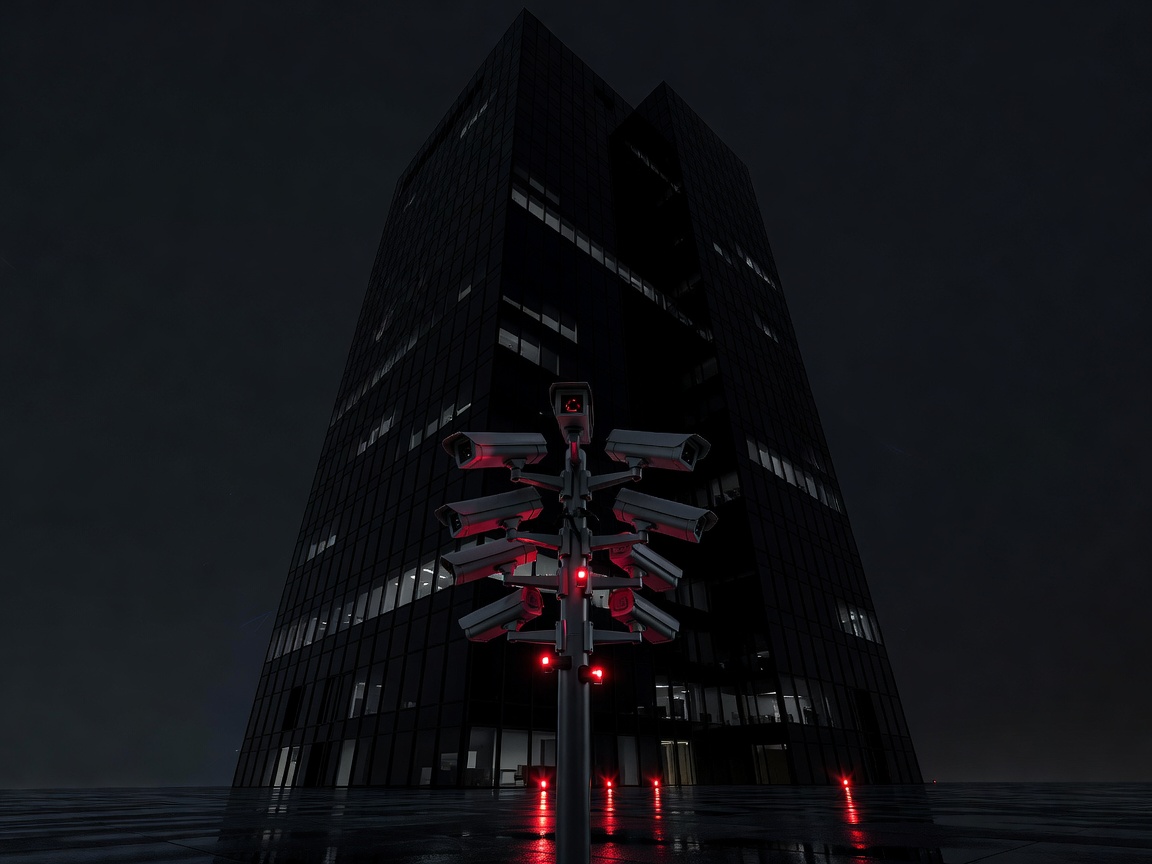
The corporation as sovereign
Cyberpunk's corporation is not a villain in the thriller sense, a company doing something illegal that the state will eventually punish. It is the state, or has replaced the functions of one. Tyrell in Blade Runner manufactures people and sets the terms of their lives. Tessier-Ashpool in the Sprawl is a family that has become a company that has become a fortress, orbiting above everyone. Arasaka and Militech in the Cyberpunk tabletop and in 2077 fight a war with each other over the heads of a city that has no army of its own. OCP in RoboCop buys the Detroit police outright, and the film's joke is that nobody in it finds this strange. Snow Crash's franchulates take the idea to its comic conclusion, with sovereignty itself sold as a franchise.
The word the early fiction reached for was zaibatsu, borrowed from the Japanese conglomerate model, and the borrowing tells you something about the anxieties of the period. The lasting idea underneath is extraterritoriality: the corporate arcology as a place where the law outside does not apply, and the street as the space left over between such places. When you are reading a new work, ask who provides the police, the water and the medicine. If the answer is a company with a logo, the theme is in play regardless of how much chrome is on show.
Artificial intelligence as a personhood question
The genre's machines rarely rise up. They ask to be recognised, or they try to escape, or they quietly become something the plot cannot categorise. Wintermute and Neuromancer want to merge, and the Turing police exist in the Sprawl precisely to stop that kind of thing, which frames intelligence as a regulated substance rather than a threat. The Puppet Master in Ghost in the Shell claims to be a life form born in the sea of information and asks for the thing any refugee asks for, a body and a future. Blade Runner's replicants are the reverse case: built as products, they want the one thing the product warranty excludes. The Voight-Kampff test in that film is the genre's most famous instrument and it measures empathy, not intelligence, which is the tell. Psycho-Pass's Sibyl System is the institutional version, a judging intelligence whose nature the society has agreed not to examine too closely.
The distinction that separates cyberpunk AI from the wider science fiction tradition is ownership. The question is seldom whether the machine can think. It is who holds the licence, who can switch it off, and whether the thing that thinks is also the thing that is owned. That is the same question the genre asks about the augmented human, which is why the two themes travel together.
Surveillance: from the panopticon to the feed
The lineage here runs through Jeremy Bentham's panopticon design and Michel Foucault's reading of it in Discipline and Punish: the prison in which the possibility of being watched does the work of the guard. Philip K. Dick's short story The Minority Report, and the film made from it, moves the watching backwards in time so that guilt precedes the act. Psycho-Pass makes that pre-emptive measurement the basis of an entire criminal justice system. Watch Dogs builds a whole city, its Chicago, around a fictional operating system that sees everything and lets the player borrow its eyes, which is the genre's most honest admission that surveillance is seductive from the inside.
The interesting gap is in the founding texts. Gibson's Sprawl is astonishingly under-surveilled by later standards; nobody carries a tracked device, and the console cowboy's anonymity is assumed. Reading it now, the missing phone is the loudest thing on the page. Later work, from Mr. Robot's obsessive operational security to the feed-saturated cities of recent games, corrects the omission, and the correction is where the genre feels most contemporary. Shoshana Zuboff's The Age of Surveillance Capitalism is the non-fiction companion for readers who want the argument that the watched street is now a business model rather than a police tactic.

Rebellion: punk, not revolution
The punk half of the compound is the contested one. The genre's protagonists are freelancers: Case takes a job, Molly takes a job, Shadowrun's runners take a job, V takes a job. The heist is the default plot shape, and the heist is not a revolution. It is a transaction conducted against the system rather than an attempt to replace it. This is the basis of the long-running criticism that cyberpunk offers style without politics, that the mirrorshades reflect the corporation without ever really opposing it. The defence is that the genre is describing a world in which organised opposition has already lost, and that survival with attitude is what resistance looks like after that.
Both positions have their exhibits. The Matrix has an actual resistance in Zion and is the least ambiguous of the canon about it. Akira's biker gangs and student protesters are politics as chaos rather than programme. Mr. Robot's fsociety is the revolution that succeeds and immediately discovers what it has broken. Edgerunners is the tragic version, where the crew's loyalty is the only political unit that holds and it is not enough. What the genre almost never provides is a functioning alternative institution. The street finds its own uses for things, but it does not found a parliament.
The body and the self
Under all four arguments sits the modified body. Cyberpunk 2020's cyberpsychosis and Shadowrun's Essence give the loss a mechanic; Ghost in the Shell gives it a philosophy, the ghost as whatever remains when the shell is entirely replaced; Deus Ex's Icarus imagery gives it a myth. Alita treats the cyborg as salvage and the salvage as a person. The recurring anxiety is not that the body will be changed but that the change will be owned by someone else, on a lease, with a kill switch. That returns you to the corporation, which is where the genre always ends up.
Reading the themes against each other
| Theme | Canonical text | The question it asks |
|---|---|---|
| Corporation | RoboCop, the Sprawl trilogy | Who provides the police? |
| Artificial intelligence | Ghost in the Shell, Blade Runner | Who holds the licence on a mind? |
| Surveillance | Psycho-Pass, Watch Dogs | What does being watched do before any crime? |
| Rebellion | The Matrix, Edgerunners | Is a heist an act of politics? |
| Body | Akira, Alita | Who owns the change? |
Most strong works in the genre pick one of these as the primary question and let the others supply texture. When a work tries to answer all five at once, it usually ends up answering none, which is a useful thing to notice before you commit forty hours to it.