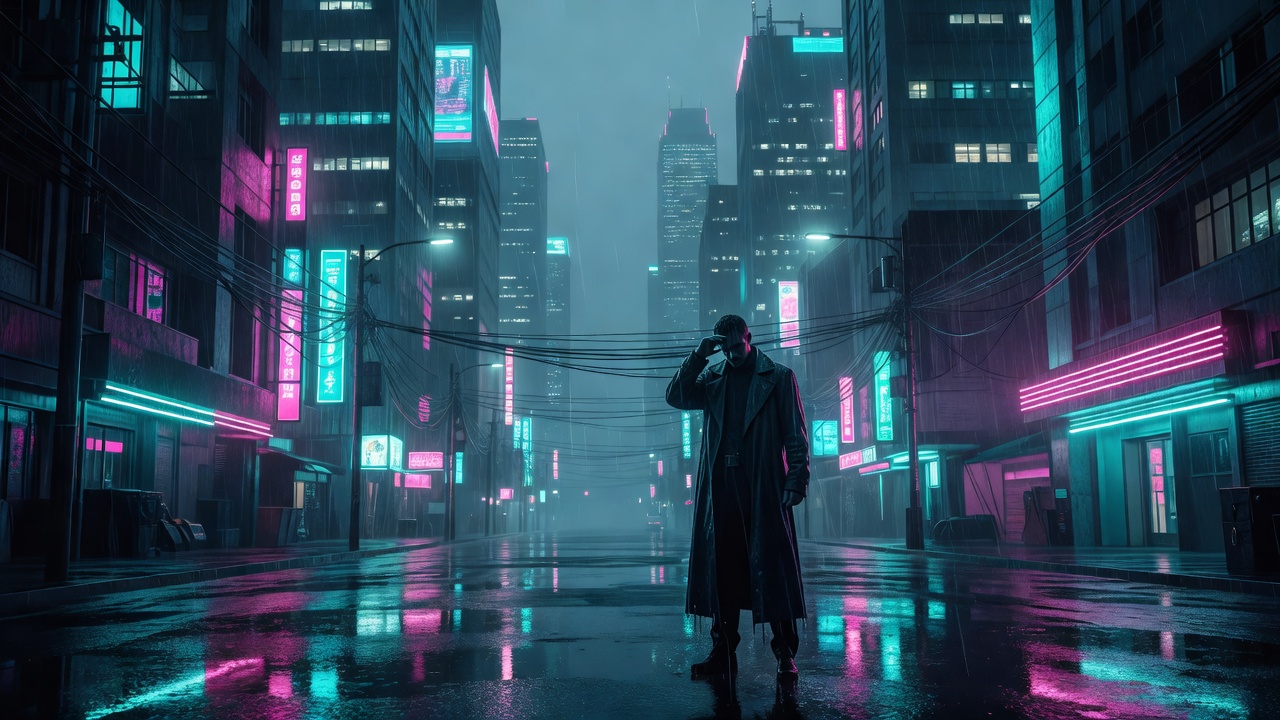
High tech, low life
The genre is a city. Start walking.
Five guides for people who already know what ICE is and want the distinctions that matter: how hacking gets abstracted on screen, why the Japanese branch is not an adaptation of the American one, which novels built the sentence, where the colour palette actually comes from, and what the corporation is standing in for.
The five guides
Games
Immersive sims against tabletop ports, hacking as a design problem, augmentation with a cost column, and cities built for looking up. From System Shock's wireframe cyberspace to Night City's signage density, with the smaller runs worth your time.
Open the games guideFilm & Anime
Blade Runner set the grammar and everything since negotiates with it. Akira, Ghost in the Shell and Lain ask different questions entirely. Action cyberpunk against interior cyberpunk, and a working test for what belongs on the list.
Open the film guideBooks
The Sprawl trilogy and the shape of its sentences, the Mirrorshades crowd, the precursors that make the movement legible, and the satirical, post-cyberpunk turn that followed. A reading order that respects the argument rather than the chronology.
Open the reading guideStyle
Kowloon density and Shinjuku signage layered onto a Los Angeles chassis. Where cyan and magenta come from, why wet asphalt matters, what techwear inherits from mirrorshades and trench coats, and the sound from the CS-80 to darksynth.
Open the style guideThemes
The corporation as sovereign, artificial intelligence as a personhood question rather than an uprising, surveillance from the panopticon to the feed, and the argument over whether cyberpunk's rebellion is politics or just posture.
Open the themes guide
Working vocabulary
Terms the guides assume
Not a primer. A quick alignment on which sense of each word the site uses, since several of them mean slightly different things depending on whether you came in through the Sprawl, the tabletop or the screen.
- ICE
- Intrusion Countermeasures Electronics. Defensive software guarding a system in Gibson's cyberspace; black ICE is the variety that kills the intruder's body through the deck.
- Simstim
- Simulated stimulus. A full sensory feed of another person's experience, broadcast or recorded. Molly's point of view riding into Case's head is the reference example.
- Sprawl
- The Boston to Atlanta metropolitan axis of Gibson's first trilogy, and by extension any continuous urban mass that has stopped having edges.
- Ripperdoc
- Cyberpunk 2020's word for a back-street implant surgeon. The tabletop origin matters: the term carries a price list and a risk of infection with it.
- Netrunner
- The tabletop lineage's hacker class; the screen equivalent of Gibson's console cowboy and Shadowrun's decker. Same job, different rulebook.
- Wetware
- Biological hardware: the brain and nervous system considered as a computing substrate. Rudy Rucker used it as a title; the genre uses it as a shrug.
- Arcology
- A self-contained city-building. In the fiction it is nearly always corporate, nearly always sealed, and nearly always the thing the street is standing in the shadow of.
- Mirrorshades
- The reflective sunglasses that became the movement's emblem and the title of Bruce Sterling's anthology. The point is the surface: they give nothing back.