The grammar Blade Runner wrote
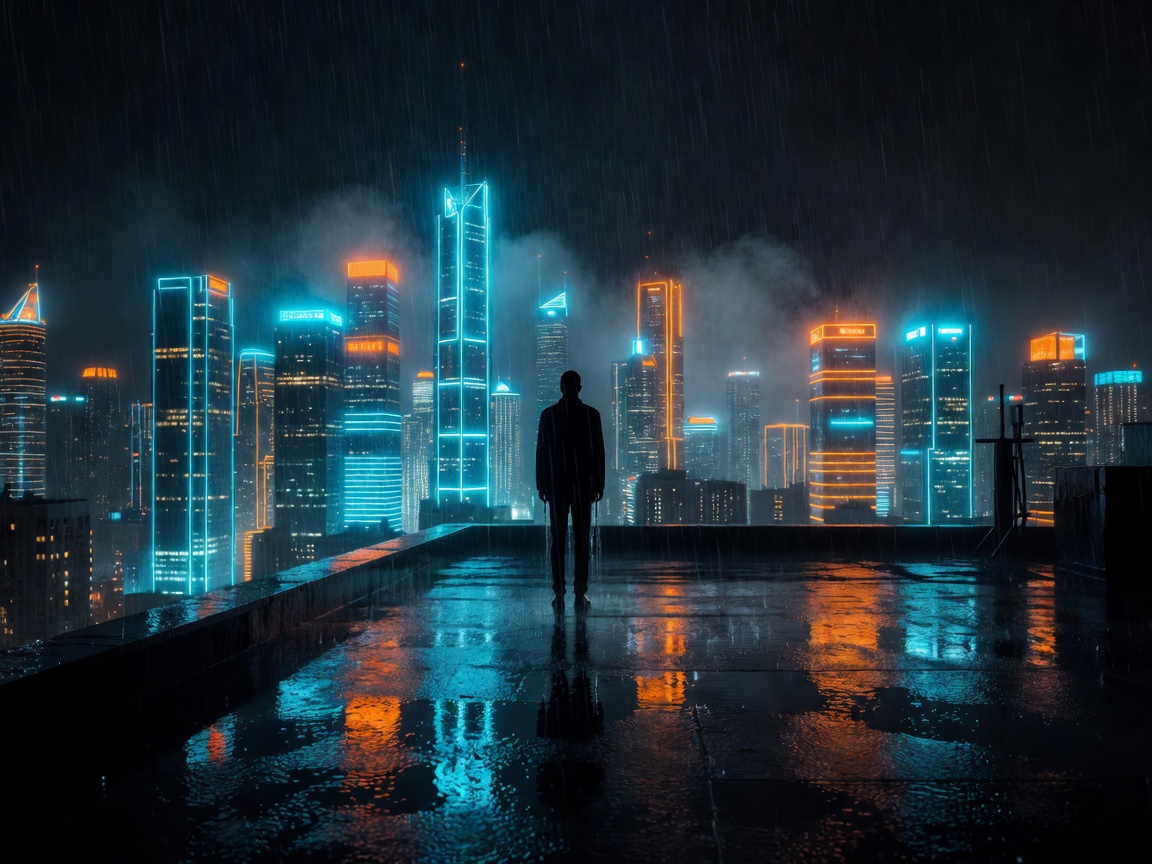
Whatever you think of its pacing, Ridley Scott's film is the reason the genre has a look. Syd Mead's retrofitted Los Angeles, where new technology is bolted onto old buildings rather than replacing them, gave cyberpunk its central visual rule: nothing is ever clean, and the future accumulates rather than arrives. The rain doubles every light source on the pavement. The noir chassis, a detective, a case, a femme fatale who is also the question the film is asking, means the plot is investigation rather than conquest. And the replicants put the personhood problem in the centre of the frame, where the genre has kept it ever since.
Blade Runner 2049 is interesting precisely because it refuses to repeat the trick. Denis Villeneuve trades the crowded street for emptiness: the orange dust of the ruined Las Vegas, the brutalist water-lit interiors of the Wallace building, a protein farm under a grey sky. It argues that the genre's real subject was never the neon but the loneliness underneath it, and it has a strong case. Watch the two together and you have the genre's full tonal range in a single evening.
The Japanese branch is not an adaptation
The mistake newcomers make is to treat Akira and Ghost in the Shell as Japanese responses to an American idea. They are parallel developments drawing on their own sources, and they ask different questions. Katsuhiro Otomo's Akira is about the body, power and the city as a wound: Neo-Tokyo's rebuilt skyline, Kaneda's bike gang, and Tetsuo's transformation as body horror that shades into something like transcendence. There is barely a computer in it. Mamoru Oshii's Ghost in the Shell, from Masamune Shirow's manga, is the one that meets Gibson halfway, and then keeps walking: the Puppet Master is not a rogue program but an argument about what counts as a life, and Kenji Kawai's choral score makes the cyborg body sound like a ritual.
Serial Experiments Lain is the interior extreme, a series in which the Wired is less a network than a spiritual condition, and the horror is dissolution of the self rather than any villain. Texhnolyze goes further into austerity and is genuinely difficult. Bubblegum Crisis is the pulp version, with power-armoured women fighting a megacorp's rogue machines, and it is the closest anime came to Blade Runner's street directly. Battle Angel Alita, from Yukito Kishiro's manga, is the scrapyard variant: the cyborg as salvage, the floating city as the thing everyone below is looking up at. More recently, Studio Trigger's Cyberpunk: Edgerunners took the Night City setting and gave it the tragic arc the game keeps in its side quests: chrome as addiction, the crew as the only family, the ending you know is coming from the first episode.
Action cyberpunk against interior cyberpunk
The useful axis for sorting the rest is not good against bad but exterior against interior. Action cyberpunk uses the setting as an arena: The Matrix, which is also the most complete popularisation of the jacked-in premise; Strange Days, Kathryn Bigelow's simstim thriller, which is the most Gibsonian film nobody talks about; Johnny Mnemonic, uneven but built from the Burning Chrome story; Upgrade, a lean revenge film about an implant with opinions; Paul Verhoeven's RoboCop and Total Recall, which treat the corporation as satire. Dredd belongs here for its Mega-City One, even though the source is comics rather than prose.
Interior cyberpunk uses the setting to get at perception. David Cronenberg's Videodrome and eXistenZ are body horror about media and games rather than networks, and the genre owes them more than it admits. Dark City is noir with the world as a set. Gattaca is the biopunk cousin, all genetics and no neon, and clarifies how little the palette matters once the ownership-of-the-body question is in place. Brazil is bureaucratic dystopia rather than cyberpunk proper, but its duct-strewn interiors are pure retrofit and it belongs on the shelf next door.
Series that sustain the argument
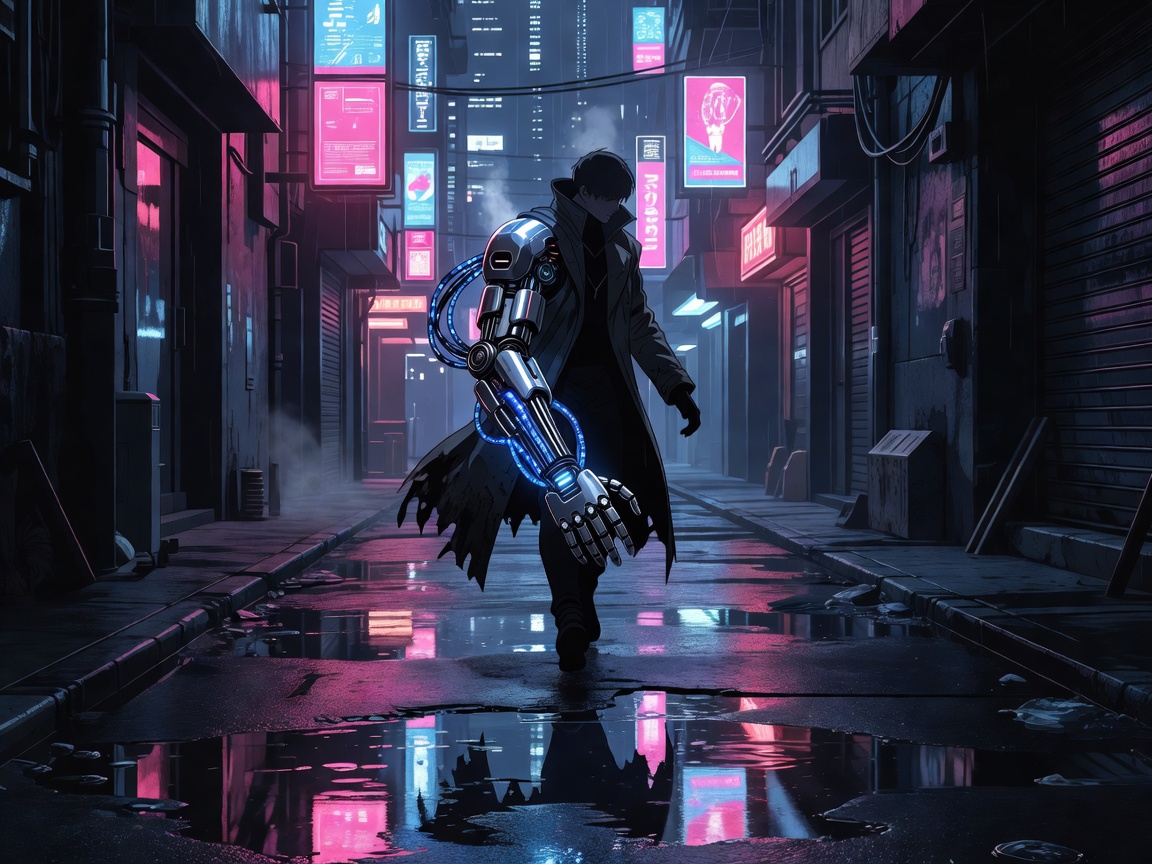
Ghost in the Shell: Stand Alone Complex is the essential series, taking Oshii's film and giving it a police procedural spine, with Yoko Kanno's score shifting the mood from elegy to momentum. Psycho-Pass makes the surveillance state its protagonist through the Sibyl System, and the first series is a tight argument about what a society does when guilt can be measured before the act. Altered Carbon adapts Richard K. Morgan's novel with more spectacle than the book needed but keeps the sleeve premise intact. Mr. Robot is hacker realism rather than cyberpunk, but its treatment of the corporation as an emotional presence is the most cyberpunk thing on television. Ergo Proxy is the one for people who found Lain too warm.
A working test for the list
The test the site uses: does the technology change what a body or a mind is, and is somebody profiting from that change? RoboCop passes. Tron is proto, since the machine world never touches the meat. A neon colour grade on its own does not qualify anything, which is why several handsome films sit just outside the fence.
The corollary is that the genre is defined by ownership rather than gadgets. A film with a mind-upload but no corporation, or a corporation but no altered body, is a neighbour. That is not a demerit. Most of the neighbours are worth your time, and the fence exists so the core stays visible.
Viewing threads rather than a chronology
- The noir thread: Blade Runner, Dark City, Blade Runner 2049. Detective, city, question.
- The body thread: Akira, Videodrome, Ghost in the Shell, Alita. What the flesh is for.
- The network thread: Strange Days, The Matrix, Lain, Stand Alone Complex. What the mind is when it is elsewhere.
- The corporate thread: RoboCop, Psycho-Pass, Edgerunners. Who owns the outcome.